
Sheet door
A cabinet door bent from 1.5 mm mild steel, with flanges and return lips.
Uses: sheet metal, assembly, mates.
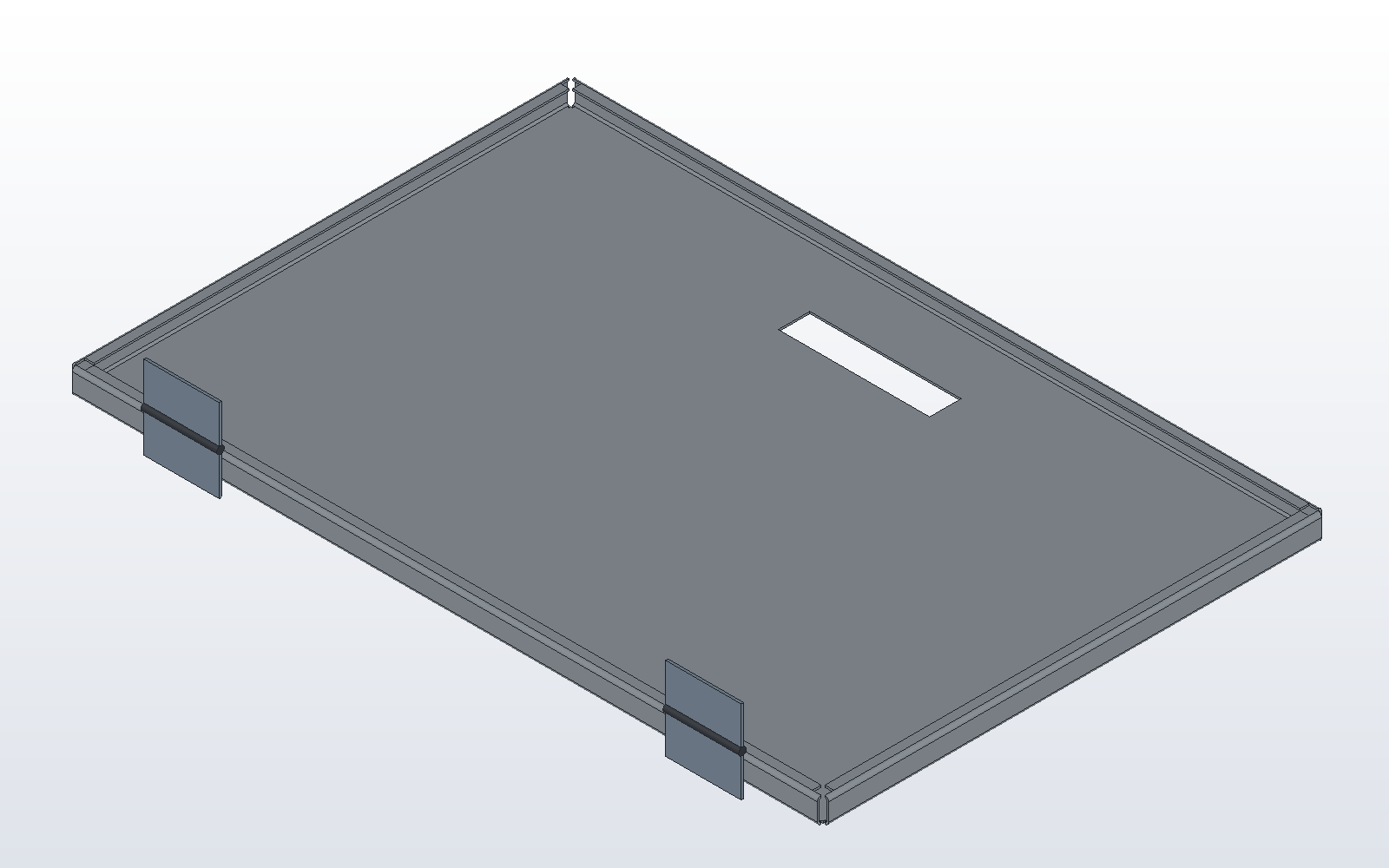
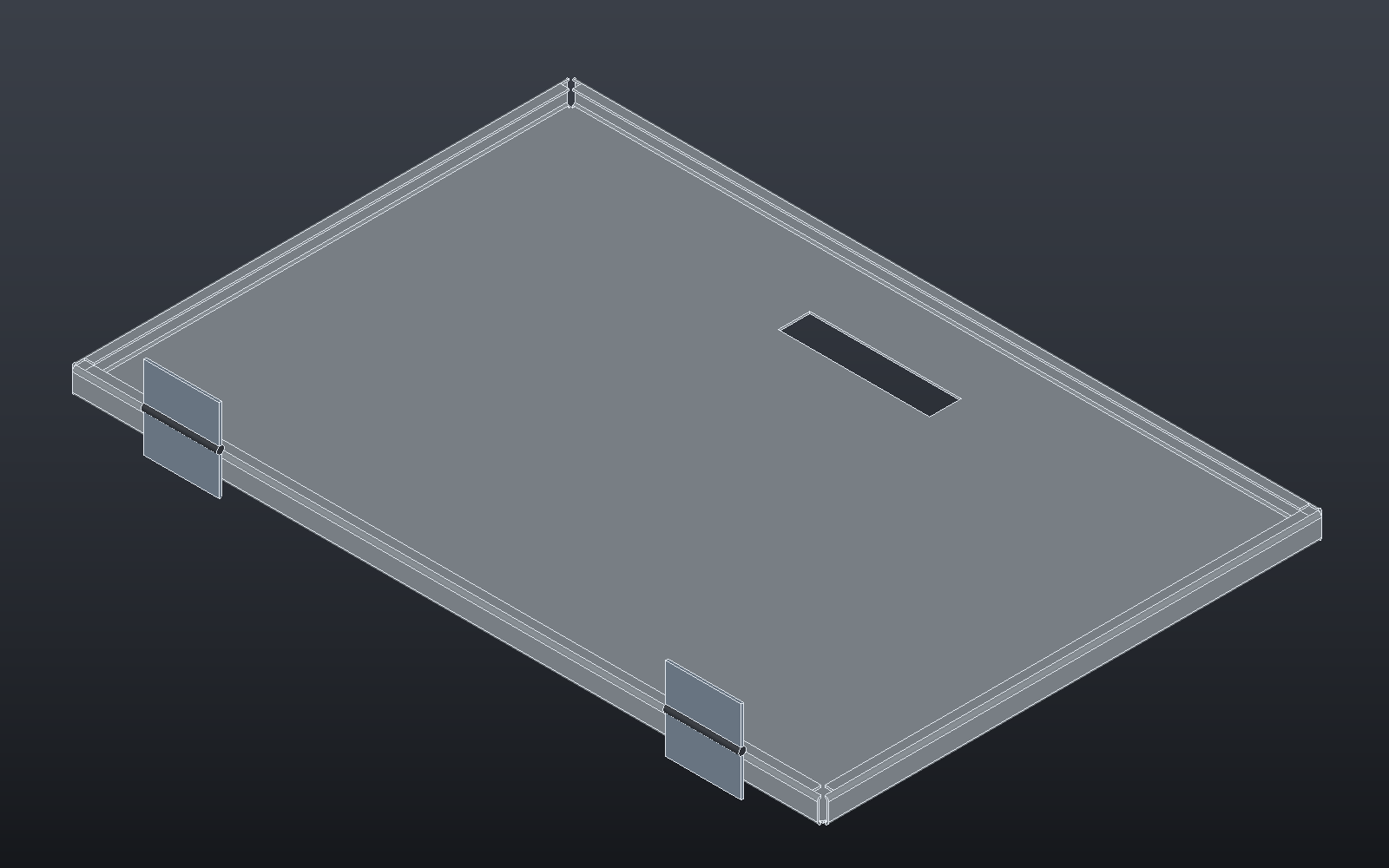
How to open it in DX-CAD
This example ships with DX-CAD. Copy it into a folder, then open it in the window:
dxcad examples sheet_door
dxcad gui sheet_door.py
To build it into a project from the command line instead:
dxcad run sheet_door.py --output sheet_door.dxcprt
dxcad describe sheet_door.dxcprt
Change a number at the top of the script and run it again: that is the whole of DX-CAD's parametric model.
This example keeps door-hinge.dxcasm beside the script.
The whole script: sheet_door.py
# SPDX-License-Identifier: Apache-2.0
"""A cabinet door bent from 1.5 mm mild steel, with flanges and return lips.

600 x 400 overall, as a drawing gives it: a 20 mm flange on every edge, each
with a 10 mm return lip, both measured to the outside, relieved at their
ends, the corners left open. The base is the overall size less a bend radius
and a thickness each side, 594 x 394. Each 20 mm flange with its return is a
14 mm leg and a 7 mm lip, once both bends' setbacks (1.5 + 1.5 = 3) are
taken off, and each bend allows pi / 2 x (1.5 + 0.44 x 1.5) = 3.39292 mm,
so every side of the flat reaches 2 x 3.39292 + 14 + 7 = 27.78584 mm past
the base. Its flat is 649.572 x 449.572 mm. The long edge at y = 0 carries
two pairs of hinge holes; the handle is a cut-out in the face, and two
rounded vent slots, 90 long and 10 wide, run across it below the handle,
each two lines and two arcs on the flat's DXF. It hangs on
the solid door's hinge, door-hinge.dxcasm, used twice and placed by mates.
Copy door-hinge.dxcasm beside this file; `dxcad examples sheet_door` does.

    dxcad run sheet_door.py --output sheet_door.dxcasm
    dxcad flat sheet_door.dxcasm --part panel

Tags: sheet, mates, assembly
"""

WIDTH = 600.0
HEIGHT = 400.0
FLANGE = 20.0
RETURN = 10.0
THICKNESS = 1.5
BEND_RADIUS = 1.5
K_FACTOR = 0.44
HOLE = 4.0
HINGES = (60.0, 474.0)
HANDLE = (120.0, 25.0)
VENT = (80.0, 10.0)

spec = SheetSpec(THICKNESS, BEND_RADIUS, K_FACTOR)
out = BEND_RADIUS + THICKNESS
base_x, base_y = WIDTH - 2 * out, HEIGHT - 2 * out
handle = (base_x / 2, base_y - 60.0, *HANDLE)
# Each vent: the centres of its two round ends, VENT[0] apart, and its width.
vents = [
    (base_x / 2 - VENT[0] / 2, y, base_x / 2 + VENT[0] / 2, y, VENT[1]) for y in (60.0, 85.0)
]
panel = base_flange(
    [(0, 0), (base_x, 0), (base_x, base_y), (0, base_y)],
    spec,
    cutouts=[handle],
    corner_treatment="open",
    slots=vents,
)
# Each hinge's leaf covers a pair of holes 34 apart, half way up the leg.
leg = FLANGE - 2 * out
holes = [(at + offset, leg / 2, HOLE) for at in HINGES for offset in (13.0, 47.0)]
for edge in range(4):
    panel = flange(
        panel,
        edge,
        FLANGE,
        return_length=RETURN,
        length_from="outside",
        start_inset=THICKNESS,
        end_inset=THICKNESS,
        relief=True,
        holes=holes if edge == 0 else (),
    )
part("panel", panel, color="galvanised")

# The hinge turned to lie along the flange, its first leaf over a pair of
# holes, its pin and second leaf above; placed off the door, then mated flush
# against the leg's outside face.
hinge = use("door-hinge.dxcasm", as_group=True)
for name, at in zip(("hinge_left", "hinge_right"), HINGES, strict=True):
    # The leaf's top at the door's top, FLANGE, so the pin clears the return.
    place(name, hinge, at=(at, -40.0, FLANGE), rotate=(0, 90, 0))
    mate(name, ">Y", "panel", "<Y", "coincident")